Human Design Core — Beginner's Guide · 5 min read
What is Human Design?
A complete beginner's guide
Human Design is a self-knowledge system created in 1987 that synthesizes four ancient
traditions — the I Ching, Western astrology, the Kabbalistic Tree of Life, and the
Hindu-Brahmin chakra system — with modern frames borrowed from quantum physics and
genetics. The result is a personal chart, called a BodyGraph, that maps how you are
wired to make decisions, take in energy, and engage with other people. This guide
walks you through the origin story, the five Types, the decision-making framework,
and how to read your own chart in under five minutes.
§ 01 Origins & history
Ra Uru Hu, Ibiza, 1987
Human Design was introduced in January 1987 by a Canadian advertising executive named
Alan Robert Krakower, who afterward took the name Ra Uru Hu. He
described the system as a download received during an eight-day mystical experience
on the Spanish island of Ibiza. Regardless of how you feel about that origin story,
the system itself is a careful synthesis — Ra spent the next two decades systematizing
it into a coherent body of work, and it has been taught continuously since.
The synthesis pulls from four classical streams and two modern ones:
- I Ching — the 64 hexagrams of the Chinese Book of Changes become the 64 Gates in your BodyGraph. Each Gate carries the archetypal theme of its hexagram.
- Western astrology — the positions of the Sun, Moon, and planets at two precise moments (your birth, and a calculation 88 solar degrees earlier) activate specific Gates.
- Kabbalistic Tree of Life — the geometric structure of the BodyGraph, with its Centers and connecting channels, is derived from the Tree of Life.
- Hindu-Brahmin chakras — the traditional seven-chakra system is reorganized into a nine-Center model that reflects an evolutionary shift Ra dated to 1781.
- Quantum physics & the neutrino — Ra proposed that neutrino streams from stars carry the information that activates the chart at birth.
- Genetics & the codon — the 64 Gates are mapped onto the 64 codons of DNA, suggesting a biological substrate for the system.
You do not have to accept the neutrino mechanism or the codon mapping for the chart
to be useful. What matters is the synthesis itself, which produces a personal map
that is unusually detailed compared to typical personality systems.
§ 02 The 5 Types
your energetic role
Everyone falls into one of five energetic Types. Your Type is determined entirely by
which Centers are defined in your chart, and it tells you the single most useful
thing about how you are meant to engage with the world. Each Type also has a
Strategy — a posture for making decisions and meeting opportunities.
9%
Manifestor
The Initiator
Manifestors are the only Type built to start things on their own without external
permission. Their strategy is simply to inform — let the people affected
by your action know what you are about to do, and then go. When Manifestors stop
informing, they meet resistance; when they inform clearly, the path opens.
37%
Generator
The Builder
Generators are the work force of the world — sustainable, life-force energy that
can build, master, and follow through. Their strategy is to respond: rather
than chasing or initiating, they wait for something to react to and notice the
sound their gut makes ("uh-huh" or "uh-uh") in response. Following that response
leads to deep satisfaction.
33%
Manifesting Generator
The Multi-passionate Builder
A hybrid Type — the sustainable energy of a Generator combined with the directness
of a Manifestor. Strategy is to respond, then inform. Manifesting Generators
move quickly, often pursue several interests at once, and skip steps that turn out
to be unnecessary. Their challenge is honoring the response before launching.
20%
Projector
The Guide
Projectors are designed to see the system — to understand other people deeply and
guide energy efficiently. They do not have sustainable Generator-style life force,
so they thrive by working with the right people in the right invitations. Strategy
is to wait for the invitation for the big things in life: career, marriage,
location, identity. Recognition is the signal.
1%
Reflector
The Mirror
Reflectors have no defined Centers and are designed to sample the health of the
community around them like a tuning fork. Strategy is to wait a full lunar
cycle (about 28 days) before making major decisions, allowing the chart to
cycle through every transit and reveal what is truly stable.
Learn more about your Type →
§ 03 Strategy & Authority
the decision framework
If you take away one practical tool from Human Design, this is it: a two-part
decision-making framework called Strategy & Authority.
Strategy is the right posture for your Type (informing, responding, waiting for
invitation, waiting a lunar cycle). Authority is the specific body-based mechanism
that tells you whether a particular yes or no is correct in this moment.
There are seven possible Authorities, determined by which Centers are defined in
your chart and in what order they connect:
- Emotional (Solar Plexus) — wait through an emotional wave; clarity comes over time, not in the moment.
- Sacral — the gut sound in the body the instant the question is asked.
- Splenic — a quiet, in-the-moment intuitive hit; spoken only once, very softly.
- Ego (Heart) — what your willpower can actually commit to and follow through on.
- Self-Projected (G-Center) — clarity that emerges when you hear your own voice talking about the decision.
- Mental / Environment — sounding it out with trusted others in the right environment.
- Lunar (Reflectors only) — wait the full ~28-day moon cycle.
The mind is brilliant at analysis and terrible at decisions. Human Design moves the
decision back into the body, where it always was. The 7-year experiment is simply
this: run your decisions through Strategy and Authority, watch what happens, and
let the evidence accumulate.
Read the full Authority guide →
§ 04 The BodyGraph
9 centers · 36 channels · 64 gates
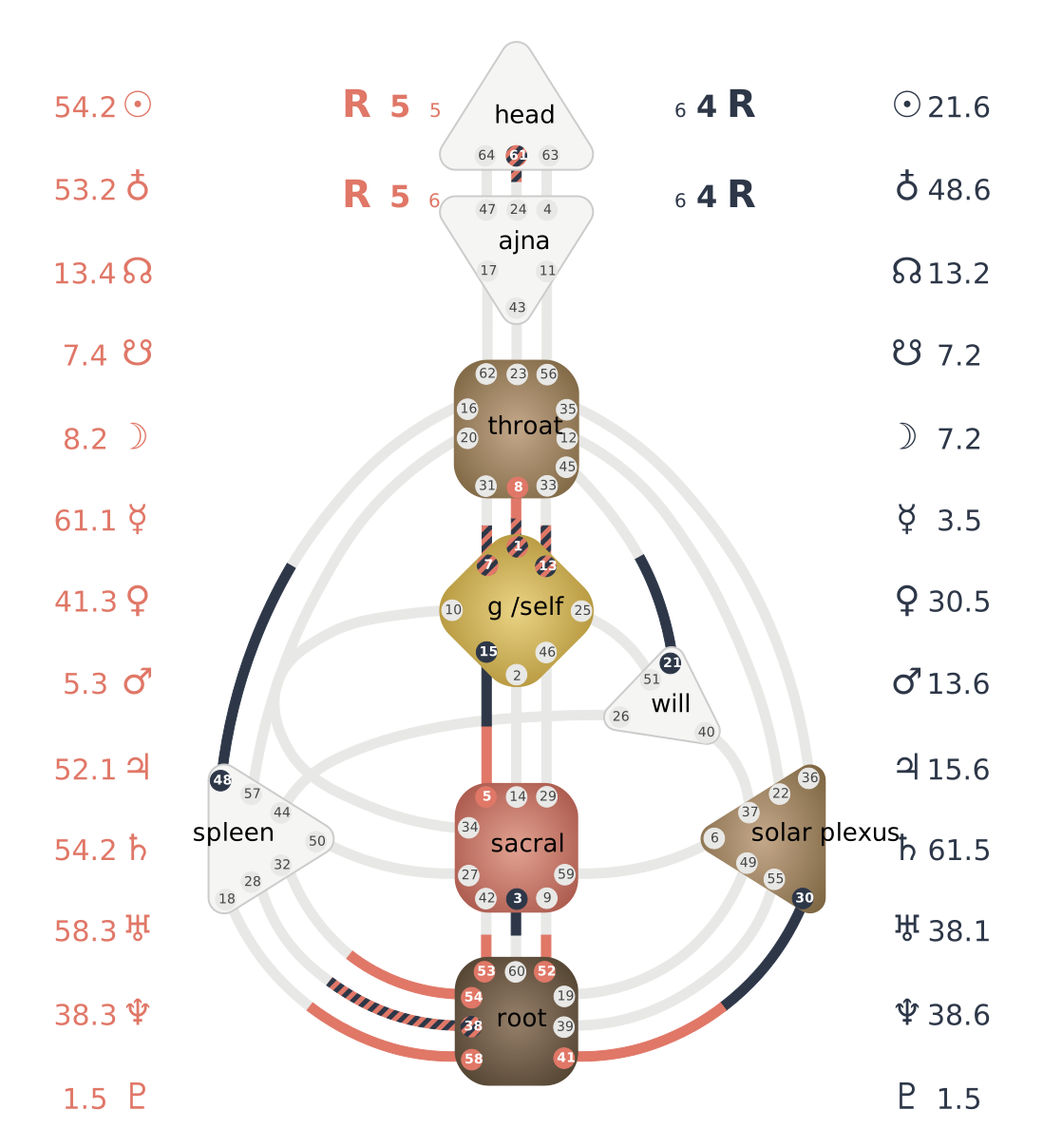
The BodyGraph is the visual heart of Human Design. Nine geometric shapes are the
Centers, each one either defined (filled with
color) or open (white). Defined Centers are a fixed, reliable
source of energy in your design. Open Centers are where you take in, amplify, and
learn from the people around you.
The lines between Centers are the 36 Channels. A complete Channel
connects two Centers and defines them both — these are your unchanging energy
patterns. The numbered points at the ends of each Channel are the 64
Gates, each one carrying the archetypal theme of an I Ching
hexagram.
Below the graphic, your reading lists your Type,
Strategy, Authority, Profile
(e.g., 1/3, 5/1), Definition, and your
Incarnation Cross — the four Gates that form your life theme.
Explore the 9 Centers in depth →
§ 05 How is HD different from MBTI, astrology, or Enneagram?
side-by-side | Human Design | MBTI | Astrology | Enneagram |
| Methodology | Birth-moment astronomy + I Ching synthesis | Self-report questionnaire | Birth-moment astronomy | Self-report questionnaire |
| Primary output | BodyGraph: Type, Strategy, Authority, Profile, Centers, Gates | 4-letter type (e.g., INTJ) | Natal chart: signs, houses, aspects | Core type (1–9) + wing |
| Time component | Exact birth time required (minute-precise) | Not used | Exact birth time required | Not used |
| Daily decision tool? | Yes — Strategy + Authority is the core practice | No — descriptive only | Partial — transits and electional | Partial — growth/stress arrows |
Human Design's distinguishing feature is the second row: it produces a personal
chart from astronomy (so it is not self-reported) and it ships with a
practical decision tool (so it is not just descriptive). MBTI gives you a label,
astrology gives you a sky map, Enneagram gives you a growth path — Human Design
tries to give you all three in one chart, with a daily-use protocol on top.
§ 06 Getting started
3 steps - 01
Generate your chart
Enter your birth date, exact time, and city. The chart returns in seconds —
free, with no email gate. Open the calculator →
- 02
Identify your Type
The top of your reading shows your Type (Generator, Manifesting Generator,
Projector, Manifestor, or Reflector) along with your Strategy and Authority.
Read your Type's section in this guide — that single concept changes more
than any other piece of the chart.
- 03
Experiment for 7–9 months
Run your everyday decisions — what to eat, who to call, whether to take the
meeting, whether to accept the offer — through your Strategy and Authority.
Keep a simple journal. After roughly seven months you will have enough data
to know whether the experiment is delivering on what it promises.
§ 07 Frequently asked questions
six quick answers Is Human Design scientific?
Human Design borrows vocabulary from quantum physics, neutrino physics, and genetics, but it is not a peer-reviewed scientific theory. It is best understood as a synthesis of mystical frameworks (I Ching, astrology, Kabbalah, chakras) presented in a modern register. Treat it the way you would treat a personality framework or a journaling prompt — an experiential tool, not a clinical diagnosis. The value is in what you notice when you try the experiment, not in whether the underlying mechanism is laboratory-confirmed.
Do I need to believe in this for it to work?
No. Human Design is framed as a 7-year deconditioning experiment, not a belief system. You read your chart, identify your Strategy and Authority, and then test them against everyday decisions for several months. Either the experiment improves the quality of your decisions and your sense of self, or it does not. Belief is irrelevant — the evidence is the data you collect from your own life over time.
What if I don't know my exact birth time?
Use the closest known time, mark the chart as a draft, and pay attention to which sections feel solid and which feel off. A 15-minute error can change your Profile (e.g., 1/3 vs 2/4) or flip a Center from defined to open. If you have access to a birth certificate, hospital record, or family memory, use that. If only the approximate hour is known, focus on the elements that change slowly — Type and Definition usually stay stable across an hour or two.
Is Human Design compatible with other belief systems or religions?
Yes. Human Design is a descriptive framework, not a religion. It does not require you to abandon any faith, philosophy, or therapeutic practice you already use. Many people layer it on top of meditation, somatic work, therapy, astrology, or Christian/Buddhist/secular practice without conflict. The Strategy and Authority are practical decision tools — they sit comfortably alongside almost any worldview.
Where can I learn more?
Start with the foundational books — Ra Uru Hu and Lynda Bunnell's 'The Definitive Book of Human Design' is the canonical reference; Chetan Parkyn's 'Human Design: Discover the Person You Were Born to Be' is the most accessible entry point. From there, explore your Type, Authority, and Profile in depth through our blog. Eventually you may want to read about specific Gates and Channels — but the first 90 days are best spent simply living your Strategy and Authority.
What makes Human Design Core different?
Human Design Core is free, multilingual (English, Korean, Japanese — native readings, not machine translation), and built with a developer-friendly REST API. The calculation engine uses Swiss Ephemeris-grade astronomy with proper IANA time zone handling. There is no email gate, no upsell wall on the basic chart, and the same engine that draws your BodyGraph here also powers the public API — so what you read on this page exactly matches what the API returns.
§ 08 Keep reading
curated next steps